Colleges in Alaska
Why go to College in Alaska?
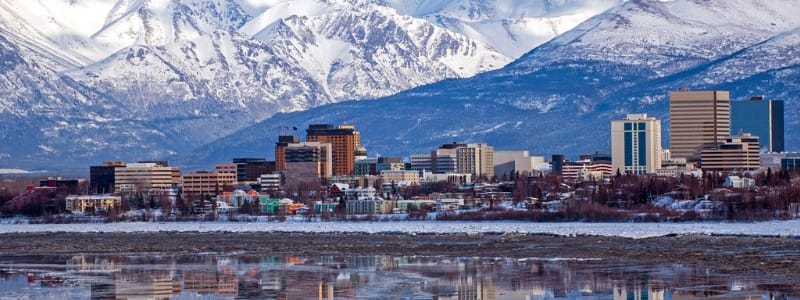
More than 1,000 miles north of any other American college or university, Alaska's institutions of higher learning provide students a truly unique experience. Students take advantage of the "Last Frontier" landscape for education, skiing, hiking, studying; and explore the endless wilderness that is home to the largest National Parks in the country. In the classroom or online, students earn degrees in fields closely aligned with Alaska's biggest industries and resources, such as oceanic studies, petroleum engineering, mining, wildlife conservation, and biology. Going to college in Alaska allows students to combine a traditional college experience with all the aspects that make the largest state in the U.S. one-of-a-kind.
What Options are Available for Colleges in Alaska?
On-Campus
A student's on-campus experience in Alaska depends on where they enroll. Many of the private and religiously affiliated schools feature small student populations and an intimate learning environment. The three UA universities are traditional larger, state schools with many undergraduate and graduate students, dormitories, lecture halls, athletic facilities, and many school services and clubs. Students can take advantage of their geographical and topographical surroundings by studying in some of UA's best departments, such as atmospheric sciences, oceanic studies, or geology. These programs send students into the Alaskan wilderness with experts to experience their subject in person, like finding rare rock formations or measuring atmospheric change.
Online Programs
Online colleges in Alaska are accessible to students in the most remote parts of the state, in the heart of Juneau, or in the continental U.S. Taught via the web, distance learners study the same material as in-person students through a combination of videos, learning materials, assignments, and digital peer interaction. Some online schools in Alaska feature web chats between students, while others use a lecture-based system with more assignments. Programs can be taught asynchronously, as well, which allows students to learn at their own pace. Others use an accelerated format to help students shave off years of study (and tuition costs).
Online degree programs can result in a bachelor's of arts or master's of science, just as on-campus programs. Online learning is particularly popular with people who are working and require a flexible schedule; students who want to pursue a program only offered at a university far from them; or students looking to finish their degree quickly.
Hybrid Programs
Hybrid programs combine many of the benefits of online and on-campus programs. A hybrid program may consist of some combination of online courses and in-person courses, or it may offer classes that require an in-person and online component. Students who are enrolled in a hybrid program have less in-class time required each week or semester, which is perfect for working students and adult learners. However, in-class components allow students to access facilities, provide social interaction with professors and peers, and develop hands-on learning that may be absent from online learning.
Popular Degree Programs in Alaska
Alaska is a vast and beautiful state, best known for its arctic wilderness and icy peaks. The Alaska landscape plays a large role in the state's most important industries and the popular college degrees. The oil and gas, fishing, mining, timber, and agriculture industries are the state's driving economic powers, and schools such as UA confer a number of degrees in each.
Geology The study of rock formations and change is important for understanding Alaska and its unique ecosystem. Geology can be used in a number of the industries that thrive in the state, such as natural gas or oil drilling, engineering, and mining.
Wildlife Biology Polar bears, black bears, caribou, and moose are a few of the many animals that make Alaska's wildlife unparalleled in the U.S. Students at UA and other schools in the state can study these animals, as well as plant life and sea life up close and personal.
Environmental Studies From oceanic to atmospheric studies, many Alaska university students focus on understanding the environment and how to conserve it. Alaska is home to a wide range of conservation groups, as well as industries that extract natural resources.
Best Online Colleges in Alaska for 2019
Students living in Alaska or the lower 48 can find some of the country's best online colleges in Alaska. This section shows some of the best online colleges in Alaska, highlighting degree programs they offer and what advantages distance learning at these institutions has to offer. This list is a resource designed to help potential learners find online schools in Alaska that best fit their needs and requirements. This list focuses on how each program fulfills a student's educational goals, as well as outlining financial and logistical components necessary for the decision making process.
Top 3 Colleges in Alaska for 2019

Admissions Rate
39%
Graduation Rate
52%
Online Enrollment
14%
Retention Rate
56%
Default Rate
7%
Surrounded by Anchorage's trail system, APU provides students with a personalized educational experience. Originally named the Alaska Methodist University, APU was the first private liberal arts college in Alaska and is still a Methodist-affiliated institution. One of the top online colleges in Alaska, the school offers two online business degrees: a BA in business administration in management and a combined accelerated business administration and management/MBA program.
The BA in business administration and management emphasizes project-based learning with concentrations in nonprofit management and health care management. The combined program offers concentrations in finance and health services administration. This fast-track option allows professionals to reduce the time it takes to graduate without compromising program quality. Online programs at APU are delivered through the Blackboard LMS.
Visit SiteSponsored
How We Ranked the Schools
To determine the best programs, we looked at the most important factors prospective students, mainly common predictors of future success and a school's commitment to online programs. This boils down to admissions rate, student loan default rate, retention rate, graduation rate, and the percent of students enrolled in online classes. All data points are taken from information provided by colleges and universities to the National Center for Education Statistics.
Each factor is weighted evenly in order to give an objective view and determine the best online master's in management information systems programs. To calculate our rankings, we looked at a school's ranking when organized by a single factor, and then averaged each category's ranking to find an overall score: Admissions Rate (20%) + Default Rate (20%) + Retention Rate (20%) + Graduation Rate (20%) + Percent of Students Enrolled in Online Classes (20%) = Final score.
Education Trends in Alaska
Nearly one in every five Alaska residents holds at least a bachelor's degree by the time they're 25, and one in 10 have a graduate degree. These rates are nearly in line with the U.S. average. The amount of money spent per full-time student — and the percentage of tax revenue allocated for higher education — in Alaska are both more than twice the national average.
| Alaska | United States | |
|---|---|---|
| Postsecondary Education Spending per Full-Time Student | $14,112 | $6,954 |
| Percent of Tax Revenue Allocated to Higher Education | 11.2% | 5.8% |
| Percentage of adults over 25 with associate degree | 8.1% | 8.1% |
| Percentage of adults over 25 with bachelor's degree | 17.9% | 18.5% |
| Percentage of adults over 25 with graduate degree or higher | 10.1% | 11.2% |
| Source: SHEEO and U.S. Census | ||
Paying for College in Alaska
One of the most important factors for prospective college students is the cost of tuition. Cost is a critical concern with either in-person schools or online colleges in Alaska. From tuition and fees to books, housing, and transportation, paying for college can be intimidating. However, in-state tuition for public schools in Alaska is actually much less than many other public universities, and lower than the national average.
Tuition Prices
Alaska is home to some of the lowest public four-year tuition rates in the United States. An Alaskan can earn a bachelor degree for just about $7,000 a year in tuition and fees, well below the national average. There are only a handful of states in the U.S. that feature lower public four-year rates.
*Public Two Year Average In-State Tuition and Fees data unavailable for Alaska
Financial Aid
Every U.S. college student can apply for financial aid through the government by completing the FAFSA, the Free Application for Federal Student Aid. This form, which can be completed online, allows students to see what funding opportunities they may be eligible for from the federal government and their school. Grants and scholarships, such as the Pell Grant, are given to students who have financial need or merit in a specific field. These financial gifts pay for tuition or other school costs and do not need to be repaid.
Students can also receive work-study funding, where the government pays students a stipend for work they do at their school. Direct, subsidized, and Perkins loans are several of the other types of financial aid that can be given to help cover school costs. However, unlike grants or scholarships, these loans must repaid.
Cost for Online Programs in Alaska
Federal funding isn't only awarded to students who study on campus. Those at online schools in Alaska are eligible for the same funding and financial aid opportunities — from grants to loans — as their on-campus peers.
While online colleges in Alaska often have tuition rates comparable to on-campus learners, the entire learning experience may still be less expensive. Online students can save on costs traditionally associated with college, such as transportation, housing, meals, childcare, and books.
Cost of Living by Region
The cost of college varies greatly depending on where you live. Most of the schools are located in the state's larger cities: Anchorage, Fairbanks, and Juneau. Comparing their rent prices, it is clear that Fairbanks is the least expensive, but also the most remote. All three cities have rent and housing prices that are fairly similar. Other U.S. cities popular for Alaska college students include Bozeman and Seattle. Seattle is far more expensive than Alaskan college towns, but Bozeman is much less.
Scholarships for Alaska College Students
Can all Scholarships be Used for Online Programs?
Most scholarships or grants can be used at a traditional brick-and-mortar campus or at online schools in Alaska. Often the application requirements are more taxing than using them. Eligibility may be based on a number of factors, however, including full-time status. Students should ensure that a scholarship is valid for their university or online degree program before applying or accepting. There are degree-specific scholarships for online learners as well.
Employment Outlook in Alaska
Alaska is among the least populous states in the country, and therefore has a less diverse and extensive economy. However, Alaska is still home to several thriving sectors. The unemployment rate in Alaska is close to the national average and below 5%. Similarly, the annual average wage is close to the national mean salary across sectors. The U.S. annual mean wage is $49,630, while the Alaska state wage is slightly lower at $44,030.
| Alabama | United States | |
|---|---|---|
| Unemployment Rate, May 2017 | 4.7% | 4.3% |
| Annual Mean Wage, May 2016 | $44,030 | $49,630 |
| Source: BLS and BLS | ||
Top Employers and Industries in Alaska
Top Industries in Alaska
Trade, Transportation, and Utilities: Gas, Petroleum, and transportation are among the biggest industries in Alaska. The energy industry, which the Bureau of Labor Statistics has grouped with trade and transportation, is one of three "legs" in the economic stool of Alaska.
Government: The government is a major sector in Alaska. In addition to state government positions, there are numerous military and department of the interior posts throughout the Frontier State.
Education and Health Services: The largest private business in Alaska — along with several of the topi 20 — are healthcare providers. In combination with universities, the health and education sector makes up a sizable portion of the Alaskan economy.
Top Employers in Alaska
Providence Health and Services: 4,000+ employees
Wal-Mart/Sam's Club: 3,000+ employees
Safeway: 2,750+ employees
State Exchange Programs for Alaska College Students
Students at online colleges in Alaska can take advantage of state-to-state exchange programs. Directed at students from states with few higher education opportunities, these state-to-state programs allow students to enroll in another state's program with a reduced or in-state tuition price. These programs are perfect for online learners who want to expand their educational horizons without paying out-of-state tuition rates.
Available to students who apply, WUE allows students from participating states to pay as little as 150% of in-state tuition at another participating state university or college. Students can apply directly through their WUE school.
Eligible States: Alaska, Arizona, California, Colorado, Hawaii, Idaho, Montana, Nevada, New Mexico, North Dakota, Oregon, South Dakota, Utah, Washington, Wyoming, and the US Pacific Territories and Freely Associated States.
Accreditation for Colleges in Alaska
A school's accreditation is important for students to consider before selecting in-person or online school in Alaska. When a school is accredited, it means that other peer institutions, regulatory bodies, and government agencies certify the school as having met a set of criteria for a degree-granting institution. An accredited school's degree carries the weight of academic rigor and prestige that employers and peers respect.
Schools are accredited either nationally or regionally. Most colleges and universities are accredited regionally by one of six accrediting agencies, depending on the school's location. Regional accreditation is more popular and seen as more prestigious. It can apply to brick-and-mortar schools and online schools; private as well as public institutions. The six agencies are composed of peer institutions and recognized by the Department of Education and the Council for Higher Education Accreditation. These two organizations set standards for accreditation, but do not accredit schools themselves. National accreditation is less common and typically applies to small religious, vocational, and some online schools. Alaska schools are regionally accredited by the Northwest Commission on Colleges and Universities.
In addition to school accreditation, individual programs can be accredited by a professional association. For example, the American Bar Association accredits specific law programs.
Resources for Students in Alaska
ACPE Success Center The Alaska Commission on Postsecondary Education has a Success Center website that provides free career and college services, from helping students decide on a college to filling out the FAFSA.
ACPE Scholarship Help Students can use the ACPE website to locate scholarship opportunities directly from the state as well as find financial aid information and make payments.
DEED Parent and Student Help The Alaska Department of Education and Early Development offers a variety of tools for students and their parents or all ages. The resource includes help for high school and college students in Alaska.
AKCIS Portal The Alaska Career Information System — or AKCIS — is aimed at college students in the state to help them find careers after graduation. The free service works in conjunction with the ACPE and Alaska's Department of Labor.
University of Alaska Resources Students in the state's largest university system, the University of Alaska, can use the school resources to help them do everything from navigate financial aid to involvement in student life.